Converting Interest into Customers
That is what WE ARE ALL ABOUT!
Increase My Conversion

The Differences between Digital & Traditional Marketing Models
Today with Digital Marketing we are focused on the multiple of ways that lead a customer to engagement, usually through search and making inquiries, which leads to conversion. Marketing in the past often refers to different ways to gain awareness through Branding, usually in a linear manner.
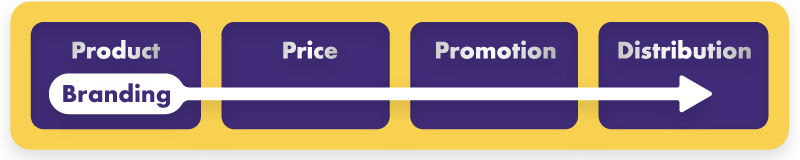
To illustrate these concepts, we compare the ‘Digital Branding Marketing Model’ with a ‘Traditional Branding Marketing Model’ as shown below.
In general, Digital or Internet Marketing is a DYNAMIC, NON-LINEAR process based on TWO-WAY communication online in real-time. Traditional Branding relies on ONE-WAY communications.
Digital or Internet Marketing Model – 7 Components
Your website and online presence are two-way communication tools with the ability to provide individual messages for different target market groups that encouraging engagement. We identify the levers (ways) that can be pushed or pulled to gain conversion in each component of the Internet Marketing Model.
There are 2 main ways of gaining online traffic;
Promotion
Search Engine Marketing plays a significant role in developing new business by driving qualified traffic to your website using organic and paid search terms. Driving qualified traffic has made Search Engine Marketing one of the most powerful new marketing channels available today. Furthermore, organic rankings (natural rankings) have the added value of being authentic, which adds legitimacy to websites that are presented by search engines at the top of their natural search results, especially Google.
Recognition
Gaining a response from interested people usually leads to a new connection and potentially new relationships. Keep in mind that specific messages or topics can bring qualified traffic to your website. Social Media and Email Marketing lead the way, while blogs and press releases can also be used as the starting point for a new relationship. Brand recognition becomes a critical tool for building awareness when developing these new relationships.
Internet Branding has 5 Main Components;
Communication
Tailored messaging aimed at your Target Market Groups is the foundation for Solid Messaging. Offering each Target Market Group messaging they can relate to increases the probability that they will stay long enough to give you the opportunity to convert them. Ultimately, this means connecting customer requirements with relevant solutions at the appropriate time.
Community
A Community really consists of many sets of relationships, built on shared interests that are interwoven through communication exchanges. Today, these online exchanges consist of Social Media Networks that grew from basic chat rooms or community sharing websites. Your Target Market Groups who are already participating on these Social networks will tend to gravitate to places that are relevant to them. Simply put, you need to be there.
Product
Having potential customers find you online requires a new approach to presenting products and services. Furthermore, customer feedback is available and it can be used for clarification when presenting products, clearing up any misunderstandings regarding products and services, creating new products, as well as for customer service purposes. Ultimately, customers can buy online.
Price
Individual interaction and a dynamic online environment will allow the seller to quickly adjust pricing and buyers the opportunity to compare pricing. In general, there is more flexibility on both sides of the exchange in this dynamic online environment.
Distribution
The Internet itself offers a new distribution channel. However, like pricing, the environment is more dynamic than traditional channels and offers the ability to deliver products and services in new ways.
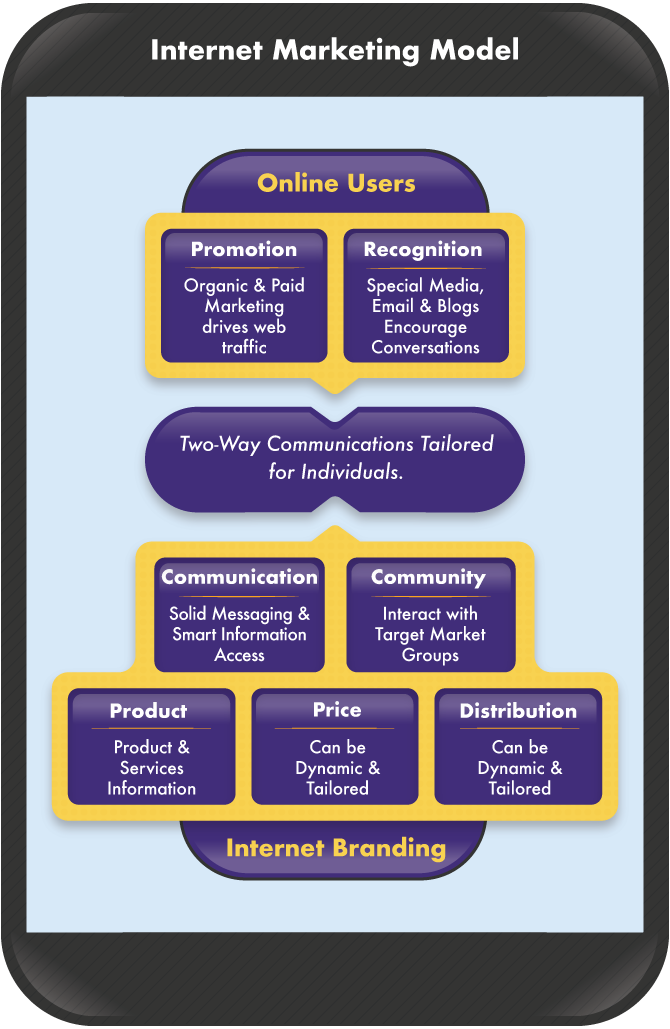
The Internet Branding Model shows that specific encouragement in each of the 5 main sections can reinforce your conversion path. Giving your visitors a great online experience and making each step of your conversion path easy, friendly and empowering will lead to higher levels of conversion. We understand that there are many ways to tailor your online communications. Our efforts help create two-way communication with visitors, which builds a relationship leading naturally to conversion.
Traditional Branding Model – 4 Components
COMMUNICATION VEHICLE: One-way broadcast media with a focused message. Traditional Marketing considers branding to be the final result of your marketing efforts, in terms of look & feel, consistent core messages, addressing specific target markets, and more – all plied into one line of through to be BRANDING.
Product
Fundamentally, products can be classified based on their position within the product life cycle (Introduction, Growth, Maturity, or Decline) and their Class (B2B or B2C). Government can be considered as another Class.
Promotion
B2B tend to have specific marketing avenues like trade shows and magazines that culminate in a personal or direct connection, while B2C has a larger array of marketing options available. The goal in both cases is to match the customer buying decision with an appropriate marketing message.
Price
Commonly we hear the term ‘Value Pricing’, or perceived benefits and how these change over time. Objectives of the seller, based on Brand Equity & Product Class, Market Penetration, Bundling along with Sales Targets, ROI, and Partner Discounts are all major factors when determining pricing strategies. Naturally, market demand is the other portion that completes the pricing equation.
Distribution
Marketing Channels that make the product or service available for purchase are the focal point. Channel structure & organization, strategic alliances and partnerships along with agents & brokers must be factored into this portion of the model.